



Description
Visual Details:
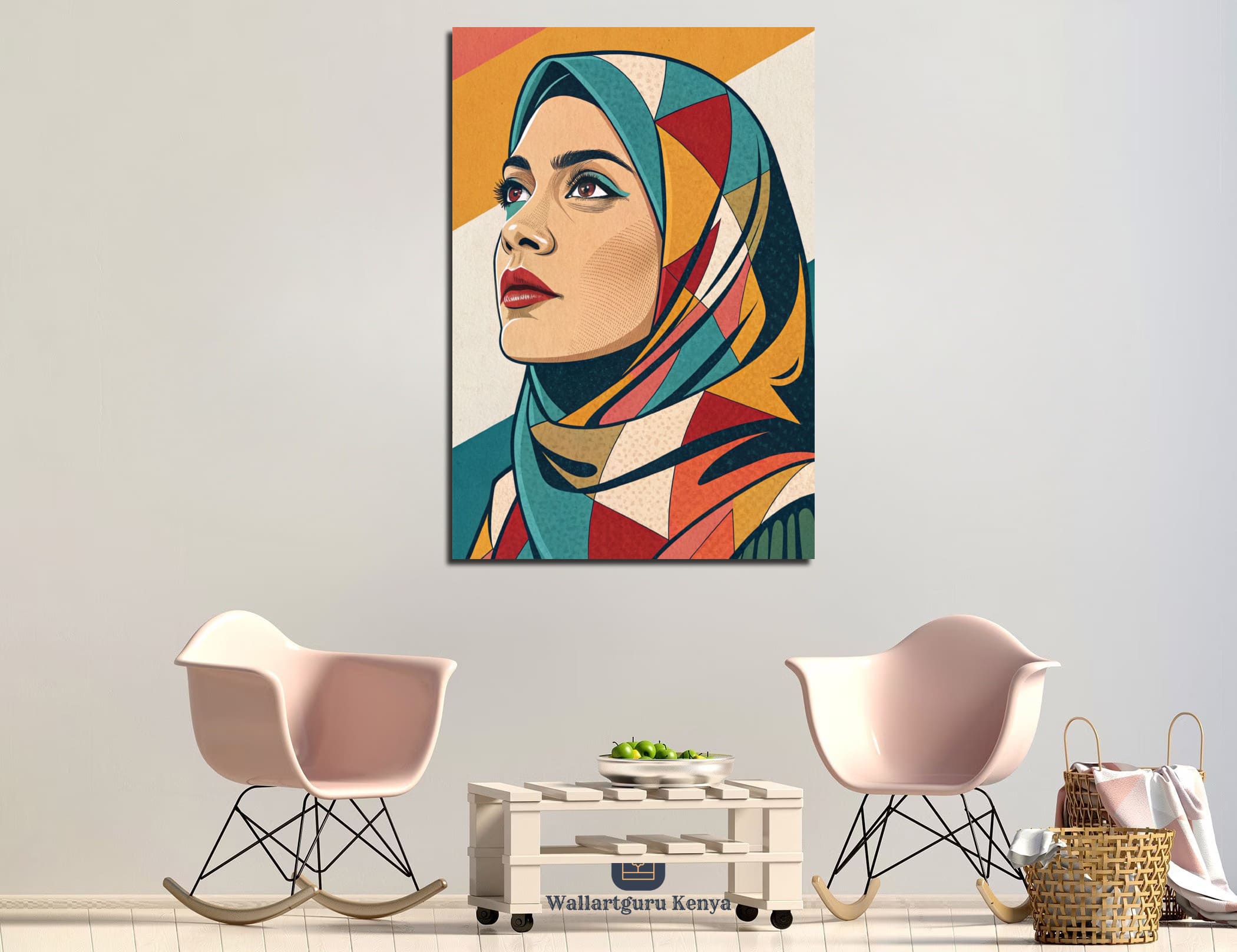
This striking contemporary portrait celebrates modest beauty through a bold graphic lens, depicting a woman in hijab rendered in the distinctive style of mid-century propaganda posters and street art aesthetics. The composition features a contemplative profile—the subject gazing upward with serene confidence, her features defined by clean geometric planes and strong contour lines. The hijab itself becomes the canvas for extraordinary color play: vibrant segments of teal, burgundy, golden yellow, cream, and orange create a mosaic-like pattern that transforms traditional modest dress into contemporary artistic statement.
The artistic execution recalls the iconic visual language of Shepard Fairey’s “Hope” poster or Soviet constructivist design—limited color palette applied in flat, bold fields with strategic shading that creates dimensional form through chromatic contrast rather than realistic modeling. The woman’s face is rendered with surprising delicacy despite the graphic approach: luminous eyes with carefully defined lashes and brows, softly contoured cheeks catching warm peachy tones, and lips in muted rose that suggest quiet strength rather than overt sensuality.
The color palette is both retro and contemporary—the teal, rust, and gold combination evokes 1960s and 70s design while feeling completely current. A soft cream background allows the vibrant figure to advance powerfully from the picture plane. The overall effect bridges pop art accessibility, political poster directness, and fashion illustration sophistication—creating artwork that is simultaneously visually arresting, culturally specific, and universally compelling. This is representation that refuses invisibility, modesty reimagined as bold visual statement.
FOR WHOM:
This piece speaks powerfully to Muslim women and girls seeking affirmative representation that honors modesty while celebrating beauty, strength, and contemporary identity. Ideal for collectors who value culturally diverse art, patrons building collections around themes of identity and representation, or anyone drawn to graphic portraiture with social consciousness. Perfect for those who appreciate pop art aesthetics applied to underrepresented subjects, admirers of fashion illustration, or collectors seeking artwork that bridges traditional values and modern expression.
This work resonates particularly with young Muslim women navigating contemporary culture while maintaining faith traditions, parents fostering positive identity formation in children, educators creating inclusive spaces, or anyone committed to diverse visual representation. Suitable for collectors at all levels who understand that representation matters—that seeing oneself reflected in art with dignity, beauty, and contemporary style is both personal affirmation and political statement. An excellent acquisition for patrons of feminist art, admirers of street art and graphic design, or anyone who values artwork that challenges stereotypes while maintaining aesthetic sophistication.
WHERE TO DISPLAY:
- Bedrooms and dressing areas for Muslim women and girls—daily affirmation of beauty and identity
- Living rooms and family spaces in Muslim households as proud cultural representation
- Children’s and teenagers’ rooms fostering positive self-image and cultural pride
- Islamic schools, community centers, and mosques creating welcoming, affirming environments
- Modern offices and professional spaces for Muslim professionals expressing cultural identity
- Boutique retail environments particularly modest fashion boutiques, hijab shops, or culturally conscious lifestyle stores
- University cultural centers and student lounges celebrating campus diversity
- Healthcare facilities and counseling spaces serving diverse communities
- Contemporary art galleries in collections focused on identity, representation, or pop art
- Hotels and hospitality spaces in multicultural cities or regions with significant Muslim populations
- Creative studios and agency spaces valuing diverse visual perspectives
- Home libraries and study areas where contemplative energy supports focused work
DESIGN NOTES:
The vertical portrait orientation makes this piece ideal for narrower wall spaces or as part of gallery wall arrangements. The bold graphic style and vibrant color palette mean this work functions as immediate focal point—it commands attention without requiring large scale, making it particularly versatile for apartments, smaller rooms, or spaces where impactful art is desired without overwhelming square footage.
Wall color consideration: The soft cream background visible around the figure means this piece adapts beautifully to various wall colors. The staging photograph demonstrates effective placement on a light neutral wall—this allows the vibrant colors to sing with maximum intensity. The work is equally compelling on colored walls: consider soft sage, dusty blue, warm greige, or even accent walls in any of the colors present within the composition (teal, rust, gold) for sophisticated tonal harmonies. Against white walls, the piece reads with crisp, gallery-quality clarity.
Ideal companion elements: This work’s retro-modern aesthetic pairs beautifully with mid-century modern furniture, Scandinavian minimalism, bohemian eclecticism, and contemporary spaces with personality. Consider pairing with Eames-style molded plastic chairs (as shown in the staging—note how the blush pink chairs echo skin tones while providing contemporary counterpoint), natural wood furniture in warm tones, brass or gold metallic accents, geometric textiles incorporating similar colors, ceramic vessels in complementary hues, and plants in simple modern planters.
The color palette—teal, rust, gold, burgundy—provides excellent foundation for room design. Pull any of these colors for textiles, throw pillows, or accent pieces to create cohesive, intentional spaces. The warm-cool balance means the piece works in both cozy, earthy environments and crisp, contemporary settings.
Scale and versatility: The square format and modest size (suggested by 450×450 filename) make this exceptionally flexible. It can function as solo statement on smaller walls, as anchor piece in gallery wall arrangements, or as part of diptych or triptych groupings for larger walls. Multiple pieces in series could create powerful impact in commercial or institutional settings.
Framing options: The graphic, poster-like quality means this work supports various presentation styles. A simple black or natural wood frame maintains contemporary edge—the black grounds the vibrant colors while natural wood adds warmth. Float mounting creates gallery sophistication. Canvas wrap without framing can enhance the pop art, street art quality. Avoid ornate frames that would contradict the piece’s modern, accessible aesthetic.
Lighting consideration: This piece thrives in abundant natural light that reveals the rich color saturation and crisp edges. Under warm artificial lighting (2700-3000K), the golds and oranges become particularly luminous and inviting. The flat application of color means the work doesn’t require dramatic directional lighting—even, ambient illumination works beautifully.
Cultural sensitivity and authenticity: This piece celebrates hijab as choice, beauty, and identity rather than reducing it to political symbol or exoticizing it. The contemporary treatment respects modesty while refusing invisibility—an important balance for artwork serving Muslim communities. When displaying in non-Muslim spaces, consider this piece’s role in creating inclusive visual environments and challenging stereotypical representations.
Curatorial opportunities: This work pairs powerfully with other portraits celebrating diverse identities—create gallery walls that represent multiple cultures, perspectives, and experiences. It also harmonizes with graphic art, pop art prints, vintage posters, or contemporary illustration. The piece’s accessibility and positive messaging make it suitable for intergenerational spaces where both youth and adults engage.
Educational and social value: Beyond aesthetics, this piece performs cultural work—it normalizes hijab in mainstream visual culture, provides positive representation for Muslim girls and women, and challenges viewers to expand their conception of beauty and contemporary identity. In educational settings, it can spark valuable conversations about representation, diversity, and the intersection of tradition and modernity.
Gift consideration: This makes an exceptionally meaningful gift for Muslim women celebrating milestones—graduations, new homes, professional achievements—or for young girls choosing to wear hijab. It communicates support, affirmation, and celebration of identity.


Reviews
There are no reviews yet.